IGNITED BY
PASSION
THE BRAND
Bianchet was founded by Rodolfo and Emmanuelle Festa Bianchet with a clear ambition: to create a Swiss watchmaking maison dedicated to design, advanced engineering, and the tourbillon as its central complication.
From the very beginning, the brand was envisioned as a fusion of Italian and French cultural heritage with Swiss micro-engineering excellence. Each creation is defined by proportion, innovation, and mechanical purity.
THE FAMILY
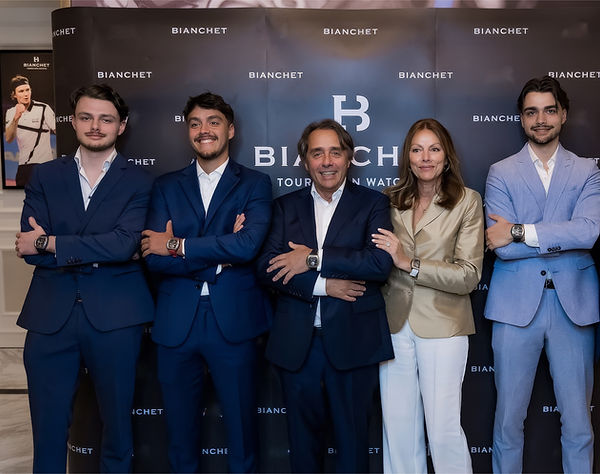
At its core, Bianchet is a united family working together on a shared project. The brand is led by Rodolfo and Emmanuelle Festa Bianchet, along with their three triplet sons. Each family member has specific responsibilities and makes daily decisions that shape Bianchet as it exists today. Although their roles may differ, the brand's direction is always discussed collectively.
The growth of Bianchet is guided by constant dialogue, reflection, and hard work. Ideas are exchanged openly, choices are debated, and a long-term vision is developed step by step. Every voice is important in defining the brand's future and determining how it will get there.
The family works with honesty, rigor, and a desire for continuous improvement, staying true to its values while advancing the brand.
.jpg)
Bianchet’s roots go beyond watchmaking and are anchored in a family culture shaped by entrepreneurship, design, and craft.
HERITAGE
SWISS
Bianchet was established and developed in Switzerland, an area where mechanical watchmaking is an integral part of daily life.
The region is characterized by a dense network of workshops, movement constructors, and component specialists, all of whom contribute to an extensive knowledge base. Each component of a watch is thoroughly analyzed, refined, and perfected through extensive experience.
This environment has laid the technical foundations for Bianchet from its inception. In this part of Switzerland, watchmaking is approached as a discipline focused on structure and performance. The movements are conceptualized as mechanical systems first, with balance, reliability, and durability serving as the primary indicators of their worth.
The tourbillon, distinguished by its complexity and architectural significance, has naturally emerged as the centerpiece of the brand's mechanical philosophy. Each Bianchet timepiece is machined, bevelled, and assembled entirely within the Manufacture in La Chaux-de-Fonds, where engineers and artisans work under the same roof from raw component to finished watch.


ITALIAN
On the Italian side, the family traces its roots to the Festa name, originating from northern Italy and its long-standing textile traditions. In 1888, Stefano Lora established a wool trading business in Trivero.
His sons, Ottavio and Severino, carried that foundation further with Fratelli Lora & Co., a mill positioned along the Sesia River in Quarona. Craftsmanship was always a matter of patience and material understanding; the first in the region to harness hydroelectric power, expanding over time into a worsted spinning mill supplying the Italian domestic market.
In 1926, Giacomino Festa Bianchet, Rodolfo's grandfather, joined forces with the Lora family, and from that union, Lora Festa was born. A heritage of industry and entrepreneurial spirit has run through the family ever since.
This Italian background introduced a strong sensitivity to materials and proportion into the family’s cultural foundation, shaping an intuitive understanding of how form interacts with the body and how objects are meant to endure.
FRENCH
On the French side, this heritage is closely linked to architecture. Jean-Louis Girodet, father of Emmanuelle Girodet Festa Bianchet, an architect based in Lyon, dedicated his work to geometry, proportion, and the relationship between structure and human scale. His career developed at a time when architecture relied on drawing, research, and rigorous thinking rather than speed or effect.
He worked on major public projects, including the Gare de Lyon Part-Dieu, where clarity of structure and flow were essential. His approach earned him national recognition and led to his selection as the Grand Prix de Rome winner, followed by a multi-year residency at the Villa Medici.
During his time in Rome, he carried out extensive research on the Golden Ratio and the structural systems built around it. Proportion was not a reference in his work, but a method. He studied how balance, rhythm, and mathematical relationships shape architecture over time.
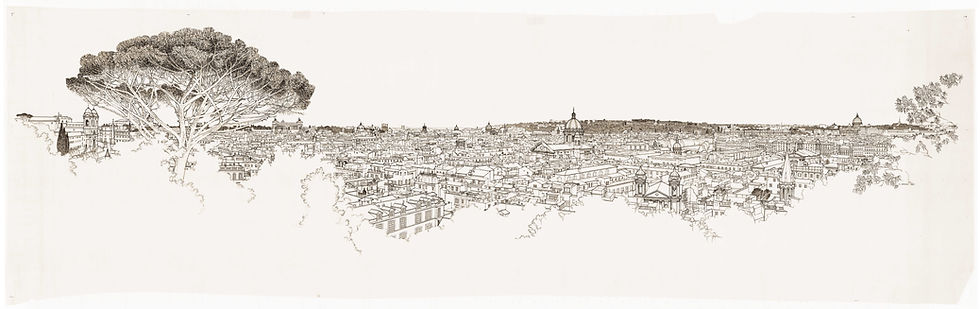
From this period remain architectural studies and drawings, including a panoramic view of Rome, which took three full years to complete, reflecting a measured and coherent reading of the city.